
Olin-Huntsman Names Integration Team, Plans Four-Division Charge For $400 Million Synergy Capture
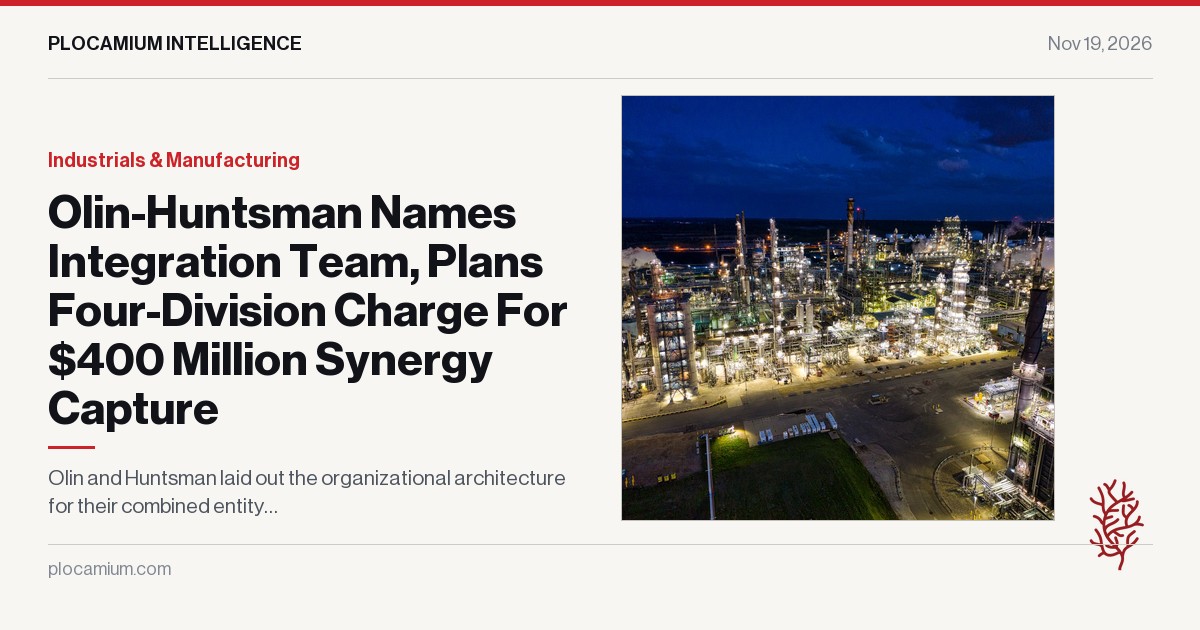
- Olin and Huntsman plan to capture $400 million in cost synergies and integration benefits following an anticipated early Q1 2027 close.
- The combined company will operate through four divisions with Essential Chemicals representing approximately 40% of 2025 combined sales as the largest segment.
- Ken Lane, currently Olin's president and CEO, will lead the merged company and has advanced pre-closing integration planning beyond typical stages to achieve 'day one readiness'.
- The organizational structure centralizes supply chain, procurement, and IT under a new Enterprise Services group to strip out duplicative functions and benchmark against industry-leading operational efficiency standards.
Olin and Huntsman laid out the organizational architecture for their combined entity, detailing a four-segment structure designed to begin to capture $400 million in cost synergies and integration benefits following close and positioning the merged chemicals giant as a vertically integrated cost leader from upstream chlor-alkali to downstream specialty formulations. The announcement names four division presidents and signals aggressive integration planning ahead of an anticipated early Q1 2027 close .
$400 million
the cost synergy and integration benefit target that OlinHuntsman expects to begin to capture following closing, according to Ken Lane, who will lead the combined company as president and CEO. Lane, currently president and CEO of Olin, framed the structure as designed for "day one readiness," implying pre-close integration work has already advanced beyond typical merger planning stages .
Lane stated: "The new company's operating structure and pre-closing integration planning position us to ensure day one readiness and begin to capture $400 million of cost synergies and integration benefits immediately following closing. This is the right team of leaders who bring the experience and passion to deliver on our priorities: operating safely, serving our customers and delivering long-term value to our shareholders" .
The announcement matters because it reveals the strategic logic underlying a consolidation in global chemicals: vertical integration from commodity chlor-alkali feedstocks through differentiated downstream products, creating a platform that competes on cost at the bottom of the value chain while capturing margin expansion in advanced materials and specialty applications. The organizational design also centralizes supply chain, procurement, and IT under a new Enterprise Services group, a signal that OlinHuntsman intends to benchmark against industry-leading operational efficiency standards and strip out duplicative functions .
Essential Chemicals: The Cash Engine
Deon Carter will lead the Essential Chemicals division as senior vice president and president, overseeing a segment that represents approximately 40% of the combined company's 2025 sales. This division integrates Olin's existing Chlor Alkali Products and Vinyls businesses with upstream Epoxy operations and the Ethyleneamines business currently part of Huntsman's Performance Products segment .
The strategic rationale centers on chlorine derivatives economics. By combining global-scale chlorine and caustic soda production with downstream chlorine-derivative businesses including ethyleneamines, OlinHuntsman aims to position itself as an industry-leading, low-cost producer across a broader portfolio. The division is explicitly designed for disciplined cost management and stronger cash generation, language that suggests mature, commodity-like economics where operating leverage and cost position determine returns .
40%: the proportion of 2025 combined sales that Essential Chemicals will represent, making it the largest segment by revenue and likely the primary cash generator funding downstream growth investments and shareholder returns.
The integration extends beyond traditional chlor-alkali products. Including ethyleneamines, which serve as intermediates for agrochemicals, surfactants, and specialty coatings, broadens the chlorine-derivative footprint and increases utilization of captive chlorine capacity. This matters in commodity chemicals where capacity utilization drives unit economics and small improvements in fixed-cost absorption translate to meaningful margin expansion .
Polyurethanes and the 2031 Integration Milestone
Steen Weien Hansen takes the role of senior vice president and president of Polyurethanes, a segment representing approximately 30% of the combined company's 2025 sales. The division includes Huntsman's existing Polyurethanes segment, excluding Thermoplastic Polyurethanes, plus Huntsman's Maleic Anhydride business from the Performance Products segment .
2031: the year when the Polyurethanes segment will begin benefiting from integrated chlorine supply from the Essential Chemicals division. This timeline suggests existing supply contracts or tolling arrangements that extend through the remainder of the decade, after which captive feedstock integration delivers incremental margin capture. The five-year lag between close in early 2027 and full feedstock integration in 2031 implies that the $400 million synergy target does not yet include the full value of vertical integration .
Polyurethanes chemistry serves construction insulation, automotive seating, flexible foams, and coatings markets. The segment's positioning as a "global integrated leader and growth platform focused on operational excellence and select innovation" indicates management views this as a margin-expansion vehicle rather than a pure cost-optimization play. The versatile chemistry language points to application development and customer co-innovation as value drivers, contrasting with the Essential Chemicals emphasis on cost leadership .
Starting chlorine integration in 2031 creates a second wave of synergy capture beyond the $400 million initial target, potentially adding further cost reduction and margin expansion as existing third-party supply contracts roll off and captive feedstock replaces merchant purchases.
Advanced Solutions and Winchester: Specialty Margin Plays
Scott Wright will serve as senior vice president and president of Advanced Solutions, a segment representing approximately 15% of combined 2025 sales. The division combines Huntsman's Advanced Materials, Thermoplastic Polyurethanes, and Performance Amines businesses with Olin's Epoxy Formulated Solutions operations .
This segment blends technologies and application expertise to create customer-focused solutions, targeting margin growth through innovation rather than scale. The vertical integration story continues here: Advanced Solutions sources cost-advantaged feedstocks from both the Essential Chemicals and Polyurethanes segments, creating a three-tier value chain from commodity chlor-alkali through intermediate polyurethanes to differentiated formulated solutions .
15%: the share of 2025 sales for both Advanced Solutions and Winchester, making each segment equal in revenue contribution despite vastly different end markets and business models.
Brett Flaugher will lead Winchester as senior vice president and president, overseeing the small-caliber ammunition business that serves U.S. and international military customers, sporting ammunition markets, law enforcement, and related products. Winchester's 160-year brand equity and position as the largest supplier of small-caliber ammunition to the U.S. military provides stable cash flows and operates independently from the chemicals value chain .
The decision to maintain Winchester as a standalone division rather than divesting signals management's view that the business generates attractive returns on capital and that ammunition demand remains resilient across military, law enforcement, and sporting channels. The emphasis on "disciplined management" suggests tight working capital control and inventory management, critical in a business with cyclical sporting demand overlaid on stable but contract-driven military sales .
Leadership and Integration Architecture
Phil Lister will serve as chief financial officer of OlinHuntsman, while Todd Slater takes the role of chief integration officer, a position that underscores the complexity of merging two global chemicals manufacturers with overlapping product lines, shared customers, and geographically dispersed production assets .
The Enterprise Services group centralizing supply chain, procurement, and IT for the chemicals businesses represents a structural mechanism to accelerate synergy capture. By consolidating these functions, OlinHuntsman aims to standardize processes, eliminate redundant systems, and leverage combined purchasing power across raw materials, utilities, and logistics. This approach has become standard in industrial consolidations, but execution varies widely. Success depends on implementation discipline and retaining critical institutional knowledge during organizational redesign .
The company characterized its organizational design as "data-driven, with clear lines of accountability and incentive programs that drive results." This language suggests performance-based compensation tied to synergy milestones and operational metrics, aligning management incentives with integration execution and post-merger financial targets .
The Plocamium View
OlinHuntsman's four-division structure reveals a coherent industrial logic: capture commodity economics at scale in Essential Chemicals, drive margin expansion in Polyurethanes once 2031 feedstock integration kicks in, and extract innovation-driven returns in Advanced Solutions while Winchester provides stable cash generation outside the chemicals value chain.
The $400 million synergy target beginning at close is aggressive but defensible given the overlapping functions in two global chemicals companies. However, the real value creation story extends beyond 2027. The 2031 chlorine integration milestone for Polyurethanes represents a second synergy wave that the $400 million initial target likely excludes. If polyurethanes raw material costs decline by even a mid-single-digit percentage through captive chlorine supply, the margin impact on 30% of combined sales compounds meaningfully over time.
Institutional investors should focus on three metrics post-close: cash generation from Essential Chemicals to fund downstream investments and shareholder returns, Polyurethanes margin trajectory as 2031 integration approaches, and Advanced Solutions revenue growth as a signal that innovation and customer co-development efforts are gaining traction. Winchester provides portfolio stability but limited growth optionality.
The broader context matters here. Lenzing's $31 million investment in specialty fiber production at its Alabama site reflects similar strategic positioning: shifting from commodity to specialty products with higher margins and differentiated value propositions . Lenzing's investment is part of a $50 million global program targeting nonwovens growth, including $23 million at its Austria site, demonstrating that specialty product expansion requires coordinated, multi-site capacity additions rather than standalone facility upgrades .
OlinHuntsman's structure mirrors this logic at larger scale. By maintaining cost leadership in Essential Chemicals while building specialty capabilities in Advanced Solutions, the company hedges commodity cycle exposure while participating in higher-margin growth markets. The question for investors is execution: Can management deliver the $400 million in year-one synergies while simultaneously building out specialty capabilities and preparing for 2031 polyurethanes integration?
The integration officer role is critical here. Todd Slater's explicit mandate to accelerate synergy capture suggests OlinHuntsman learned from prior chemicals mergers where integration dragged and cost-saving targets slipped. Day-one readiness language indicates pre-close integration planning has advanced further than typical merger preparation, reducing execution risk but increasing complexity if the close timeline extends beyond early Q1 2027.
The Bottom Line
OlinHuntsman's four-division blueprint and $400 million synergy target position the combined entity as a vertically integrated cost leader with optionality in specialty chemicals and stable cash generation from Winchester. The structure balances commodity scale economics with margin-expansion opportunities in downstream businesses, creating a portfolio that should generate consistent free cash flow across chemical cycles.
Institutional capital should monitor integration execution post-close and track progress toward the 2031 polyurethanes feedstock integration milestone, which represents a second wave of value creation beyond initial synergies. The market will price the merger on near-term cost savings, but the real returns accrue to investors who recognize the multi-year integration roadmap and specialty product positioning. OlinHuntsman trades under the OHN ticker upon close, expected early in Q1 2027, providing a clear catalyst timeline for positioning ahead of execution milestones .
Sources
- [1] Chemical Engineering. "OlinHuntsman outlines structure for new merged company." chemengonline.com
- [2] Chemical Engineering. "Lenzing to invest $31 million in specialty-fiber production at Alabama site." chemengonline.com
This report is for informational purposes only and does not constitute investment advice or an offer to buy or sell any security. Content is based on publicly available sources believed reliable but not guaranteed. Opinions and forward-looking statements are subject to change; past performance is not indicative of future results. Plocamium Holdings and its affiliates may hold positions in securities discussed herein. Readers should conduct independent due diligence and consult qualified advisors before making investment decisions.
© 2026 Plocamium Holdings. All rights reserved.