
QatarEnergy De-Risks Hormuz Exposure, Bets on Namibia's Light-Oil Windfall Reshaping Southern Africa Supply
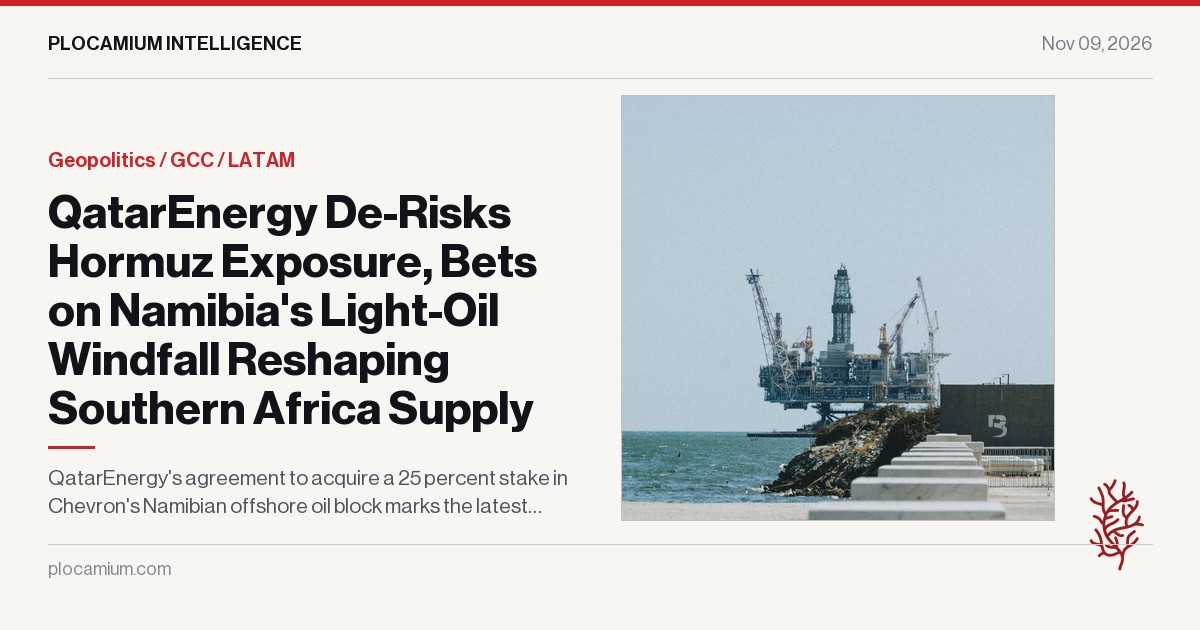
- QatarEnergy acquired a 25 percent stake in Chevron's Namibian offshore oil block (PEL 0082) covering approximately 11,450 square kilometers, with Chevron retaining 55 percent and Namibia's Namcor and Custos Energy each holding 10 percent.
- Namibia's Orange Basin holds an estimated 11 billion barrels of light oil and 2.2 trillion cubic feet of natural gas reserves, with projections that development could more than double Namibia's GDP by 2040.
- Gulf sovereigns are diversifying away from Strait of Hormuz concentration risk by deploying upstream capital into southern Africa, as evidenced by QatarEnergy's concurrent 20-year agreement to purchase up to three million tonnes per annum of LNG from Louisiana.
QatarEnergy's agreement to acquire a 25 percent stake in Chevron's Namibian offshore oil block marks the latest data point in a structural shift: Gulf sovereigns are deploying upstream capital into southern Africa's emerging hydrocarbon frontier, hedging concentration risk in the Strait of Hormuz while positioning ahead of project FID timelines that could reshape continental supply by decade's end.
The transaction sees QatarEnergy enter Petroleum Exploration License 0082, which covers blocks 2112B and 2212A across approximately 11,450 square kilometers at water depths ranging from 350 to 2,300 meters . Post-close, Chevron retains 55 percent working interest, with Namibia's state-owned Namcor and private player Custos Energy each holding 10 percent stakes. The deal requires customary regulatory approvals,.
"We are pleased to further strengthen our relations with Chevron through this agreement, and to expand and diversify our footprint in Namibia," said Saad Al Kaabi, Qatar's Minister of State for Energy Affairs and QatarEnergy chief executive .
Why institutional capital should care: Namibia's offshore Orange Basin holds an estimated 11 billion barrels of light oil and 2.2 trillion cubic feet of natural gas reserves . The US-based International Trade Administration projects that commercially viable development could more than double Namibia's gross domestic product by 2040 . That revenue windfall would flow through equity stakes, fiscal terms, and ancillary service contracts, creating a multi-decade infrastructure and logistics investment thesis across southern Africa. QatarEnergy's entry alongside Chevron validates the technical and commercial assumptions underpinning that forecast and signals that project timelines are compressing.
Gulf Sovereigns De-Risk Hormuz Exposure Through Geographic Diversification
The Namibian transaction fits a deliberate geographic strategy. Last month, QatarEnergy signed a 20-year agreement to purchase up to three million tonnes per annum of liquefied natural gas from Woodside Energy's Louisiana LNG project, a move designed to hedge supply disruption risk through the Strait of Hormuz . Doha is layering US supply commitments with African upstream positions, creating a portfolio that balances proximity to Asian demand with insurance against geopolitical chokepoints.
Namibia offers specific technical and fiscal advantages. The Orange Basin discoveries comprise light oil, a premium crude grade that commands higher netbacks and lower refining costs relative to heavier Middle Eastern benchmarks. Water depths of 350 to 2,300 meters place PEL82 within the operational envelope of existing subsea technologies and do not require the frontier deepwater infrastructure that inflates capex in pre-salt or ultra-deepwater plays. The fiscal regime remains under negotiation as Namibia's government finalizes upstream petroleum legislation, but early indications suggest competitive terms designed to accelerate first oil.
QatarEnergy's partnership structure mirrors its approach in other frontier basins: align with a supermajor operator (Chevron in this case), take a minority stake that limits capital exposure while preserving upside optionality, and co-invest alongside local state entities to secure social license and regulatory goodwill. The company is replicating the model across multiple Orange Basin blocks, working with Shell and France's TotalEnergies on separate acreage .
Namibia as the Next Guyana: Precedent and Probability
Namibia's government faces the same trade-off: maximize near-term fiscal take or optimize speed to first production and cumulative revenue over the asset life.
QatarEnergy's timing is deliberate. Chevron and its partners have completed seismic acquisition and are moving toward exploratory drilling. Entry at this stage allows QatarEnergy to participate in appraisal upside without bearing the full cost of reconnaissance-phase dry holes. and QatarEnergy's need to replace reserves as legacy fields mature.
African Upstream Expansion Complements North Field LNG Buildout
QatarEnergy's international upstream activity runs parallel to its domestic North Field expansion, the largest LNG project in history. Revenue from those volumes will fund international upstream and downstream acquisitions, creating a flywheel in which domestic cash flows finance global asset accumulation.
The Namibian play also complements QatarEnergy's April hydrocarbon discovery off the Republic of the Congo, another west African offshore position that diversifies the company's Atlantic Basin exposure. Taken together, the Congo and Namibia stakes position QatarEnergy to supply both Asian and European markets from multiple load points, reducing logistical bottlenecks and optimizing tanker economics.
The Plocamium View
QatarEnergy's Namibian entry is a leading indicator of a broader capital reallocation: Gulf sovereigns are moving upstream dollars out of mature Middle Eastern fields and into African frontier basins where reserve replacement costs are lower, fiscal terms are more competitive, and geopolitical risk is uncorrelated with regional tensions. Namibia represents the intersection of three institutional investment themes: energy security diversification, pre-FID resource exposure, and African infrastructure scalability.
The strategic logic extends beyond hydrocarbons. Namibia's GDP doubling scenario creates second-order opportunities in port infrastructure, power generation, desalination, and workforce housing. QatarEnergy's equity position in PEL82 is an upstream anchor, but the real institutional play is the multiplier effect across adjacent sectors. Expect Qatari, Emirati, and Saudi sovereign wealth funds to deploy capital into Namibian logistics and utilities as upstream development timelines firm.
The valuation calculus is straightforward. Assuming PEL82 holds a pro-rata share of the 11 billion barrel Orange Basin resource base and applying a conservative $3 to $5 per barrel for pre-FID exploration acreage, QatarEnergy's 25 percent stake embeds several hundred million dollars of net asset value at current risk-adjusted terms. If drilling confirms commercial viability and the asset moves to development, that valuation re-rates to $8 to $12 per barrel, implying a three to four times multiple on entry cost.
The risk case centers on fiscal stability and infrastructure bottlenecks., which means the entire value chain, from offshore pipelines to onshore processing facilities to export terminals, must be built from scratch. That greenfield construction risk inflates capex and extends timelines. QatarEnergy mitigates this by partnering with Chevron, whose project management capabilities and balance sheet capacity reduce execution risk, and by maintaining a minority stake that caps downside exposure.
The Bottom Line
QatarEnergy's Namibian transaction is a calculated bet on African upstream fundamentals and a structural hedge against Middle Eastern geopolitical concentration. Institutional capital should track follow-on commitments: if QatarEnergy increases its stake or enters additional Orange Basin blocks, it signals that appraisal drilling has delivered positive results and that project economics clear internal return thresholds. The next 18 months will determine whether Namibia's offshore basin becomes a Guyana-scale investment opportunity or another stranded frontier play. QatarEnergy's capital is now on the line, and where Doha leads, other Gulf sovereigns will follow.
Sources
- [1] The National News. "QatarEnergy agrees to buy 25% stake in Namibia's offshore oil block in expansion push." thenationalnews.com
This report is for informational purposes only and does not constitute investment advice or an offer to buy or sell any security. Content is based on publicly available sources believed reliable but not guaranteed. Opinions and forward-looking statements are subject to change; past performance is not indicative of future results. Plocamium Holdings and its affiliates may hold positions in securities discussed herein. Readers should conduct independent due diligence and consult qualified advisors before making investment decisions.
© 2026 Plocamium Holdings. All rights reserved.