
Saudi Aramco Faces Security Risk as Riyadh Attack Exposes Energy Infrastructure Vulnerability
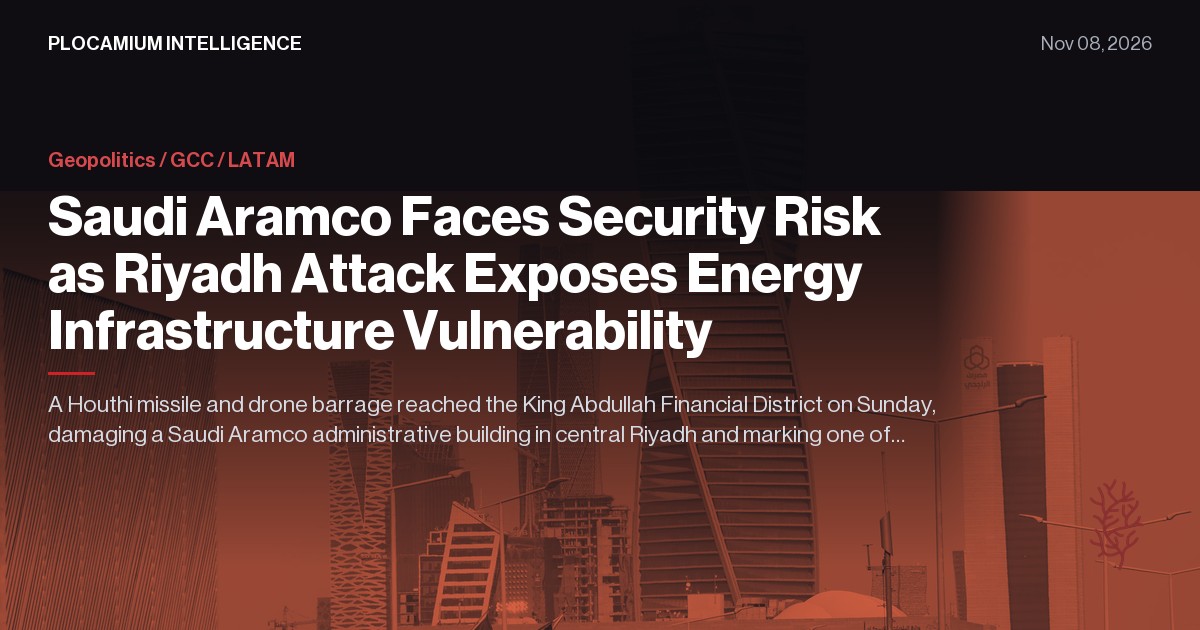
- A Houthi missile and drone attack on Sunday damaged a Saudi Aramco administrative building in the King Abdullah Financial District in central Riyadh, representing one of the deepest penetrations of Saudi Arabia's air defenses since the Yemen conflict reignited.
- Saudi Arabia's energy ministry confirmed the Aramco building sustained damage from falling shrapnel, with no injuries or fatalities reported in the incident.
- The attack exposed vulnerability in Saudi energy infrastructure protection, raising security concerns for Saudi Aramco's operations during the ongoing Yemen conflict.
A Houthi missile and drone barrage reached the King Abdullah Financial District on Sunday, damaging a Saudi Aramco administrative building in central Riyadh and marking one of the deepest penetrations of Saudi Arabia's air defences since the Yemen conflict reignited.
Saudi Arabia's energy ministry confirmed that the Aramco building sustained damage from falling shrapnel. No injuries or fatalities were reported. The Saudi-led coalition's air defences intercepted and destroyed several ballistic missiles: two aimed at Riyadh, one targeting the Eastern Province, two more in the southern region, and a drone launched by the Houthis. Coalition spokesperson Major-General Turki al-Maliki disclosed the intercepts in posts on X on Sunday. The Eastern Province target is notable. It sits atop the kingdom's oil infrastructure, home to the Ras Tanura and Rabigh refineries, both of which have been struck by the Houthis in this campaign cycle .
The Houthis, formally known as Ansar Allah, have escalated attacks on Saudi targets since a 2022 ceasefire collapsed in July, after the group announced a blockade of Saudi ports. Since that collapse, the United Nations reports more than 1,600 people killed and nearly 300,000 displaced . The Houthi military spokesperson Yahya Saree claimed coalition forces had carried out 4,369 strikes since the latest escalation began, a figure Al Jazeera could not independently verify. Houthi health officials reported 33 people killed, including eight women and 13 children, in coalition air strikes on the village of al-Shariyah near Sanaa on Saturday, with 39 others wounded.
For institutional capital with exposure to Gulf energy equities, infrastructure, or sovereign credit, the KAFD strike is not an isolated incident. It is a data point in a pattern that is accelerating.
The Geography of Risk Has Shifted Inside Riyadh
Previous Houthi attacks targeted airports and refinery perimeters. King Khalid International Airport in Riyadh, King Fahd International Airport in Dammam, the Ras Tanura refinery, and the Rabigh refinery have all been struck or targeted in this conflict cycle . One person was wounded in a Houthi strike on Riyadh airport on October 10. The Sunday strike reached the King Abdullah Financial District, the kingdom's premier commercial and financial hub. That is a materially different target class.
KAFD houses regional headquarters for multinational banks, asset managers, and sovereign-linked entities. An Aramco administrative tower sits within that district. The building that sustained shrapnel damage was described as administrative, not operational, and production was not reported as disrupted. Terms of any operational impact were not disclosed.
Our view: the market has historically priced Aramco's physical risk as a refinery and pipeline story. The KAFD strike reframes that calculus. When missiles reach the financial district of the capital, the risk perimeter expands from upstream infrastructure to the institutional and administrative core of the Saudi economy.
Houthi Targeting Logic and the Iran Alignment Variable
The Houthis have not struck at random. Their targeting sequence, airports, refineries, financial districts, follows a logic of economic disruption rather than pure military degradation. In September, the group seized much of Yemen's Red Sea coast in a rapid offensive. In October, Saudi-backed government forces launched the Dawn of Yemen operation to retake Houthi-held territory, including the capital Sanaa. The Sunday barrage is the Houthi counter-signal: escalation in Yemen produces escalation inside Saudi borders .
Iran's alignment with the Houthis is the structural backstory. The coalition's interceptions destroyed the incoming missiles, but the drone and ballistic missile inventory available to Ansar Allah has not shown signs of depletion across this conflict cycle. The group carried out attacks on five distinct target categories in the kingdom within this campaign alone: airports, refineries, financial infrastructure, border regions, and the capital.
Our view: this is not a Yemen civil war. It is a regional deterrence contest conducted through proxy escalation. Investors in Gulf infrastructure and sovereign debt need to price Iran-linked escalation risk as a persistent operating condition, not a tail event.
What the Geopolitical Backdrop Adds
The November 8 Riyadh strike lands against a broader backdrop of geopolitical flux. US midterm elections delivered a Democratic congressional majority, which analysts say may strengthen oversight of the Trump administration's foreign policy, including its posture toward Gulf allies and the Ukraine conflict . Under Trump, US military and financial assistance to Ukraine slowed sharply from prior levels, with Kyiv receiving only $8.2 billion in military aid from October 2025 to March as part of legacy pipelines, against the nearly $200 billion in cumulative US support from 2022 to late 2024 .
The implication for the Gulf: a Washington increasingly consumed by domestic political conflict, Ukraine diplomacy, and congressional investigation has less bandwidth for proactive Gulf security architecture. Saudi Arabia has expanded its own air defence capabilities, as evidenced by Sunday's interceptions, but the kingdom cannot substitute US strategic deterrence with interceptor systems alone. Gulf sovereigns watching Washington's attention fragment toward impeachment politics and Ukraine negotiations face a security environment with fewer reliable external backstops.
Investment Positioning: Energy Infrastructure Risk Premium
| Target Category | Confirmed Attacks This Cycle |
|---|---|
| King Khalid International Airport, Riyadh | Yes, including Oct. 10 casualty |
| King Fahd International Airport, Dammam | Yes |
| Ras Tanura Refinery | Yes |
| Rabigh Refinery | Yes |
| King Abdullah Financial District, Riyadh | Yes, Nov. 8, 2026 |
The progression from airport perimeters to refinery gates to the financial district of the capital is a compression of the attack radius over time. For PE investors with Gulf infrastructure exposure, specifically in energy logistics, real assets within the Eastern Province, or positions in Aramco-linked equities, the risk calculus on physical asset insurance, operational redundancy, and security capex deserves revisiting.
Aramco's production was not reported as affected by the Sunday incident. No production figures or operational impact data were disclosed. The building damage was described as an administrative facility. The Eastern Province, the kingdom's core production geography, was a separate target on the same day, intercepted before impact.
Our view: the market will likely treat the absence of production disruption as a signal that risk is contained. That reading is too narrow. The targeting of KAFD alongside the Eastern Province in a single barrage reveals a simultaneous multi-vector strategy. The near-miss on production infrastructure and the confirmed hit on a capital financial-district asset happened on the same day.
The Plocamium View
The KAFD Aramco strike is a stress test that the Gulf risk premium has not yet fully absorbed. Markets have historically anchored Aramco's geopolitical discount to production disruption risk. The 2019 Abqaiq-Khurais drone strike, which temporarily knocked out roughly half of Saudi crude output, set that anchor. Because production was not disrupted on November 8, the conventional framework will treat this as a non-event for energy supply.
That framework is the wrong one. The Houthis have demonstrated the ability to reach the financial and administrative core of Riyadh with ballistic missiles and drones, in the same sortie that targeted the Eastern Province. The escalation since the July truce collapse has followed a consistent upward trajectory: 4,369 coalition strikes claimed, repeated attacks on five distinct Saudi infrastructure categories, Red Sea coastal territory seized in September, and now a confirmed shrapnel hit inside KAFD.
The second-order play for institutional capital is not in energy equities alone. It is in Gulf sovereign credit spreads, real asset insurance pricing across the GCC, and the valuation of KAFD-adjacent commercial real estate, which now carries a demonstrated physical risk component that did not exist in underwriting models written before Sunday.
The Democratic congressional wave in Washington adds an underappreciated variable. If US foreign policy bandwidth contracts further around domestic investigations and Ukraine negotiations, the implicit security guarantee underpinning Gulf stability becomes thinner. Saudi Arabia has the air defence capacity to intercept missiles. It cannot intercept a vacuum of US strategic attention.
Investors who treat this as a one-day shrapnel story are misreading the trajectory. The Houthis are not running out of missiles, the Iran alignment is structurally intact, and the target list is expanding inward toward the kingdom's economic core.
The Bottom Line
The Sunday Aramco KAFD strike closes the distance between Yemen's conflict and Saudi Arabia's financial nerve centre. Production was not disrupted. The risk architecture was. Institutional capital exposed to Gulf energy infrastructure, sovereign credit, or commercial real estate in Riyadh's prime districts should treat Sunday's barrage not as an isolated incident but as a marker of a conflict that has moved permanently inside the kingdom's economic perimeter. The next escalation will not announce itself in advance.
Sources
[1] Al Jazeera. "Saudi Aramco building in Riyadh damaged in 'attempted' attack." https://www.aljazeera.com/news/2026/11/8/saudi-arabia-intercepts-houthi-missiles-targeting-riyadh-eastern-province?traffic_source=rss [2] Al Jazeera. "Democrats' congressional win could strengthen Ukraine's hand against Russia." https://www.aljazeera.com/news/2026/11/8/democrats-congressional-win-could-strengthen-ukraines-hand-against-russia?traffic_source=rssThis report is for informational purposes only and does not constitute investment advice or an offer to buy or sell any security. Content is based on publicly available sources believed reliable but not guaranteed. Opinions and forward-looking statements are subject to change; past performance is not indicative of future results. Plocamium Holdings and its affiliates may hold positions in securities discussed herein. Readers should conduct independent due diligence and consult qualified advisors before making investment decisions.
© 2026 Plocamium Holdings. All rights reserved.