
Viatris Pivots to Specialty Pain With $1.65 Billion Pacira Bet, Abandoning Generics Margin Defense
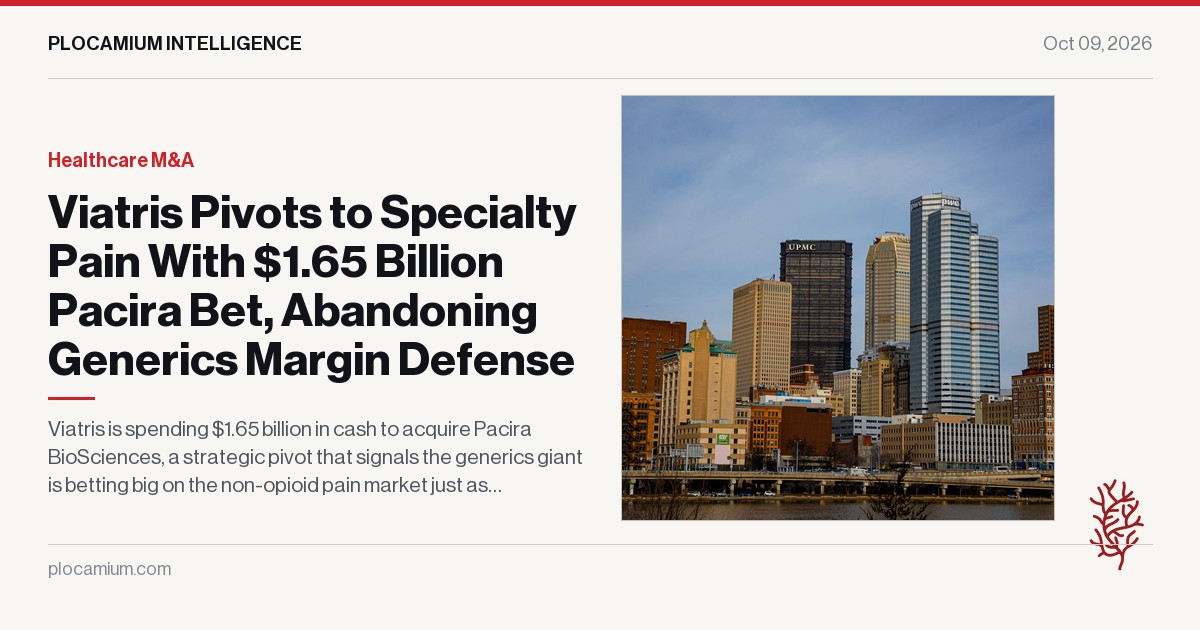
- Viatris is acquiring Pacira BioSciences for $1.65 billion in cash to pivot from generics into high-margin specialty pain therapeutics with approved, revenue-generating products.
- Vertex's FDA approval of a first-in-class non-opioid pain drug in 2026 has validated a regulatory pathway and created market demand that is driving pain sector consolidation.
- Viatris is buying Pacira's commercial-stage assets and established hospital relationships rather than early-stage pipeline risk, allowing the company to acquire revenue and infrastructure immediately.
- Unlike prior generics-to-specialty pivots by Endo and Mallinckrodt, Viatris is targeting a player with clinical adoption and formulary access across anesthesia and surgical settings.
Viatris is spending $1.65 billion in cash to acquire Pacira BioSciences, a strategic pivot that signals the generics giant is betting big on the non-opioid pain market just as regulatory tailwinds and demographic demand converge. The deal, announced October 8, 2026, positions the Pittsburgh-based company to capture share in a category freshly validated by FDA approvals and mounting clinical momentum, at a moment when institutional capital is hunting for scaled pain platforms with commercial traction .
$1.65 billion
The all-cash price tag for Pacira represents a decisive commitment by Viatris to move beyond its legacy generics and branded medicines portfolio into high-margin specialty pain therapeutics. Pacira is a commercial-stage player with approved products already generating revenue, which means Viatris is buying cash flow, not Phase II hope. The transaction comes on the heels of Vertex's recent FDA approval for a non-opioid pain drug in the same therapeutic corridor, underscoring industry-wide confidence that alternatives to opioids are no longer experimental but core to pain management strategy .
Frank Lee, CEO of Pacira BioSciences, will presumably exit with significant shareholder value creation, though his post-close role was not disclosed. The deal was structured as an outright acquisition, not a merger of equals, suggesting Viatris intends full operational control and integration into its existing commercial infrastructure.
Why This Deal Matters Now
The timing is not coincidental. Vertex's FDA approval for a first-in-class non-opioid mechanism this year has cracked open a regulatory pathway that was once theoretical. Viatris is acquiring Pacira at the inflection point where payers, providers, and patients are all aligned on reducing opioid dependence. The demographic tailwind is undeniable: aging populations in developed markets, growing surgical volumes, and heightened regulatory scrutiny on controlled substances create durable demand for pain therapies that avoid addiction liability.
This is Viatris signaling it will compete in specialty pharma on offense, not just defend generics share on margin compression. The company has historically been a cost arbitrage play, capitalizing on scale in off-patent drugs. Buying Pacira flips that script. It is a bid for pricing power, for hospital formulary access, and for the ability to cross-sell into anesthesia and surgical settings where Pacira's products already have clinical adoption.
Pain Market Consolidation Accelerates
The broader pain management sector is consolidating rapidly. Vertex's entry with a novel mechanism, Viatris's acquisition of Pacira, and continued clinical investment by Zealand and Roche in amylin-based therapies all point to a market transitioning from opioid dependence to mechanistic diversity . This is no longer about replacing one molecule with another. It is about building portfolios of differentiated mechanisms that address acute, chronic, and post-surgical pain across multiple settings of care.
Viatris is not the first generics player to pivot into specialty. Endo, Mallinckrodt, and others attempted similar pivots with mixed results, often hamstrung by opioid liabilities or failed integration. What distinguishes this transaction is the target: Pacira has commercial-stage assets with established hospital relationships, not early-stage pipeline risk. Viatris is buying revenue and infrastructure, not R&D optionality.
The deal also reflects a broader truth: generics businesses are increasingly capital-light, low-growth, and margin-compressed. Specialty pharma, by contrast, offers pricing flexibility, patent protection, and the ability to invest in sales forces that drive pull-through demand. For Viatris, this is a portfolio rebalancing exercise as much as a strategic pivot.
Regulatory and Reimbursement Context
The FDA's recent approval of Vertex's non-opioid pain drug is a watershed moment for the category. It validates the clinical and regulatory viability of novel mechanisms, reducing approval risk for adjacent players and emboldening payers to shift formulary preferences away from opioids . This is the regulatory equivalent of a green light for institutional capital: the FDA is now willing to approve drugs that redefine pain management standards, not just iterate on existing paradigms.
Reimbursement dynamics are equally favorable. Payers are under political and actuarial pressure to reduce opioid utilization, which translates into higher net pricing for alternatives. Hospitals, facing bundled payment models and value-based care contracts, are incentivized to adopt therapies that reduce readmissions and avoid opioid-related complications. Pacira's products slot into this reimbursement architecture seamlessly.
The challenge for Viatris will be execution. Integrating a specialty business into a generics operating model is fraught with cultural and operational risk. Specialty pharma requires high-touch sales, complex contracting, and deep clinical engagement, competencies that generics companies often lack. If Viatris can preserve Pacira's commercial team and avoid the typical post-merger talent flight, the deal has a chance to deliver. If integration is heavy-handed, this becomes a $1.65 billion write-down waiting to happen.
The Plocamium View
Viatris is making a calculated bet that pain will be a durable growth category for the next decade, and we agree. The confluence of demographic aging, regulatory support for non-opioid mechanisms, and payer willingness to reimburse premium-priced alternatives creates a structural tailwind that few therapeutic areas can match. But the deal is more than category opportunism. It is a signal that Viatris recognizes its generics business is terminally challenged and that capital reallocation into specialty is not optional but existential.
The $1.65 billion price will be scrutinized by analysts for implied multiples, but the real question is strategic fit. Can Viatris sell Pacira's products without destroying the commercial culture that built them? Can it cross-sell into its existing hospital relationships without alienating Pacira's existing customers? And can it defend against inevitable biosimilar or generic competition when Pacira's patents begin to roll off?
Our view: this deal works if Viatris runs Pacira as a standalone business unit with protected P&L and autonomous sales leadership. It fails if Viatris tries to extract synergies by folding Pacira into its generics cost structure. The upside is significant, a diversified portfolio with pricing power and growth optionality, but the execution risk is real.
The broader implication for institutional capital is clear: pain is now a buy-rated category. The Vertex approval, the Viatris acquisition, and the ongoing clinical momentum from Zealand and Roche all point to a sector that has moved from speculative to strategic. Private equity will take note. Expect secondary buyouts of mid-cap pain platforms, take-privates of undervalued public companies with approved assets, and aggressive M&A from Big Pharma looking to plug portfolio holes. The Pacira transaction is not the end of pain consolidation. It is the beginning.
The Bottom Line
Viatris is paying $1.65 billion to enter a market that is structurally advantaged and clinically validated, but the deal's success will hinge entirely on post-close execution. If the company can preserve Pacira's commercial capabilities while leveraging its own scale, this becomes a blueprint for how generics players can pivot into specialty. If integration is mishandled, it becomes another cautionary tale of strategic overreach.
For institutional investors, the signal is unambiguous: non-opioid pain is a conviction buy. The regulatory pathway is open, the reimbursement environment is supportive, and demographic demand is non-cyclical. The question is not whether to allocate capital to pain, but which platforms offer the best risk-adjusted entry points. Viatris just answered that question with $1.65 billion in cash.
Sources
- [1] Endpoints News. "Viatris to make $1.65B Pacira acquisition, adding to momentum in pain." endpoints.news
This report is for informational purposes only and does not constitute investment advice or an offer to buy or sell any security. Content is based on publicly available sources believed reliable but not guaranteed. Opinions and forward-looking statements are subject to change; past performance is not indicative of future results. Plocamium Holdings and its affiliates may hold positions in securities discussed herein. Readers should conduct independent due diligence and consult qualified advisors before making investment decisions.
© 2026 Plocamium Holdings. All rights reserved.