
Savannah's $2.3 Billion Terminal Bet Signals How Patient Capital Reads Supply Chain Reshoring
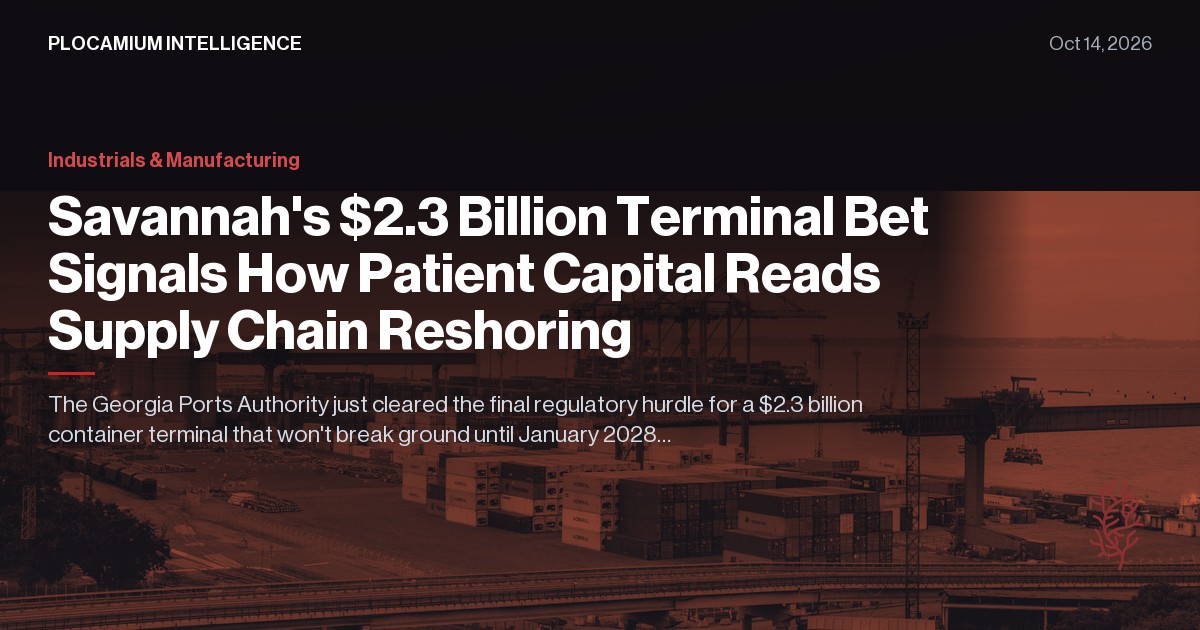
- The Georgia Ports Authority cleared a $2.3 billion Savannah Container Terminal project that won't break ground until January 2028, with operations not beginning until the early-to-mid 2030s.
- U.S. machine tool orders hit $732.9 million in August 2026, up 36.3% year-over-year, with manufacturing technology demand reaching $4.76 billion through eight months of 2026, marking the longest streak of six consecutive months exceeding $500 million in the sector's history.
- Volvo Trucks launched the VNX vocational truck in October 2026 following a $3 billion product development and manufacturing investment, targeting the vocational segment that represents roughly 25% of total truck demand.
The Georgia Ports Authority just cleared the final regulatory hurdle for a $2.3 billion container terminal that won't break ground until January 2028, yet the project already reveals more about the state of American industrial capital deployment than most deals announced this quarter. Construction timelines stretching into the 2030s, nine-figure capex commitments, and infrastructure designed for vessels that barely exist today: this is what patient capital looks like when it bets on re-industrialization rather than financial engineering.
$2.3 billion
the price tag for the Savannah Container Terminal, which received permit approval in 2026 and will target the largest container ships afloat once operational in the 2030s . The facility represents one of the largest single infrastructure investments in the Southeast, positioned to capture cargo as supply chains continue their multi-year shift toward North American manufacturing hubs. The timeline alone, spanning construction start in 2028 through commissioning potentially a decade later, reflects the capital intensity and regulatory complexity that now defines U.S. infrastructure plays.
The move arrives as American manufacturing capital expenditure accelerates across adjacent sectors. U.S. machine tool orders hit $732.9 million in August 2026, up 21.0% month-over-month and 36.3% year-over-year, marking the third-highest monthly total on record . Through eight months of 2026, manufacturing technology demand reached $4.76 billion, 36.9% above the prior-year period. Six consecutive months of orders exceeding half a billion dollars represents the longest such streak in the sector's history.
Georgia's bet matters because ports are the physical manifestation of trade policy, and Savannah is positioned at the nexus of southeastern manufacturing density. The terminal's 2028 construction start date aligns with projected capacity constraints at competing East Coast facilities and positions the port to absorb cargo as reshoring and nearshoring trends mature from headlines into capital flows.
Patient Capital Meets Infrastructure Reality
The Savannah project embodies a structural shift in how institutional capital approaches industrial assets. Traditional port expansions operated on five-to-seven-year timelines with predictable returns tied to incremental throughput gains. This terminal contemplates a decade-plus development cycle, vessels not yet built, and trade patterns still forming. That calculus only works if you believe the secular tailwinds, regulatory support, and geopolitical fragmentation driving supply chain reconfiguration are durable.
Consider the capital sequencing. Permit approval in 2026, groundbreaking in 2028, and operations beginning sometime in the early-to-mid 2030s creates a return profile that skews well beyond typical infrastructure fund life cycles. The Georgia Ports Authority is effectively underwriting future trade volumes based on manufacturing investments happening today, from battery plants to semiconductor fabs to automotive assembly operations clustering across the Southeast.
The machine tool data provides the throughline. Order values have grown nearly three times faster than unit volumes since September 2024, when the current expansion cycle began . The divergence reflects automation intensity and higher-value equipment purchases, particularly from aerospace manufacturers who now account for a rising share of total orders. These are not replacement purchases. They represent capacity additions, which eventually translate into cargo volumes requiring port infrastructure.
Volvo Trucks' October 2026 launch of the VNX vocational truck, its third all-new North American model in under three years following a $3 billion product development and manufacturing investment, underscores the capital intensity of industrial repositioning . Volvo holds just 2% to 3% of the North American vocational market, a segment representing roughly 25% of total truck demand. The company's willingness to deploy billions chasing single-digit market share in a specific truck category signals confidence in sustained industrial activity, the kind that generates port cargo.
The Manufacturing Technology Feedback Loop
The August 2026 machine tool surge carries specific implications for port throughput projections. Manufacturing technology orders serve as a leading indicator of production capacity additions, typically 12 to 18 months forward. The $4.76 billion in cumulative 2026 demand through August represents committed capacity that will materialize as operational facilities between late 2027 and 2029, precisely when Savannah's terminal construction ramps .
AMT, the Association for Manufacturing Technology maintaining the monthly U.S. Manufacturing Technology Orders series, attributed the order value and unit volume divergence to automation intensity. Aerospace demand drives part of the story, but automation integration has elevated order values across all buying segments. Higher automation content per machine translates to higher output per facility, which compounds cargo generation per square foot of manufacturing space.
Regional distribution of machine tool orders showed particularly strong growth in the West during August, where new orders hit $244.8 million . That geographic concentration matters for intermodal flows and ultimate port selection. West Coast manufacturing capacity additions create cargo that either moves east via intermodal or exits through Pacific ports, while southeastern manufacturing, the target market for Savannah's expansion, generates export and import flows directly through Atlantic and Gulf facilities.
Comparative Infrastructure Positioning
Savannah's $2.3 billion commitment sits within a broader pattern of port capital deployment that accelerated post-pandemic. The investment per berth and per annual TEU (twenty-foot equivalent unit) of capacity will likely exceed historical averages, reflecting both construction cost inflation and the technical requirements of handling ultra-large container vessels. Ships exceeding 24,000 TEU capacity require deeper berths, larger cranes, and more robust landside infrastructure than previous generations of vessels.
The facility is explicitly designed for the largest container ships, vessels currently operating primarily on Asia-Europe trades but increasingly deployed on transpacific and transatlantic routes as global shipping lines optimize fleet utilization . That design choice locks in specific operational parameters: channel depth, crane height and reach, terminal automation systems, and intermodal connectivity. It also locks in capital intensity, because accommodating these vessels eliminates the option of phased, incremental expansion that characterized earlier port development.
The 2028 construction start, two years post-permit, allows for final engineering, procurement of long-lead items like ship-to-shore cranes, and landside infrastructure coordination. It also provides a window to observe how competing ports absorb capacity and whether projected cargo growth materializes. That de-risking has value, but it also compresses the operational window before newer, potentially more efficient competing facilities come online elsewhere.
The Automation and Labor Equation
Port automation represents one of the most contentious variables in terminal economics and return projections. Savannah's timeline positions the facility to incorporate automation technologies that are pilot-stage today but likely mature by the late 2020s. That optionality matters because labor costs, productivity, and availability represent the largest operational uncertainties in long-duration port investments.
The machine tool data offers a parallel. Automation intensity is driving order values higher faster than unit volumes, indicating manufacturers are paying premiums for labor-reducing technology . Ports face identical pressures but with added political complexity. Fully automated terminals in Europe and Asia demonstrate 30% to 40% productivity advantages over conventional facilities, yet U.S. labor agreements and regulatory frameworks constrain deployment. Savannah's 2030s timeline means design decisions made in 2027 and 2028 will determine operational flexibility for decades.
Battery manufacturing technology development, exemplified by Critical Resources' August 2026 partnership with Australia's CSIRO to scale Dry Supersonic Deposition (DSD) battery production, illustrates the manufacturing process innovation occurring in parallel with port infrastructure investment . The DSD process eliminates solvents, binders, and energy-intensive drying ovens from conventional battery production, potentially reducing manufacturing costs and environmental footprint. These process innovations translate to facility location decisions, which in turn determine port cargo flows.
The Geopolitical Overlay
Port infrastructure investments carry embedded geopolitical assumptions. Savannah's $2.3 billion bet assumes U.S.-Asia trade flows remain robust despite tariff uncertainty, technology export controls, and industrial policy designed to reduce import dependence. It assumes nearshoring to Mexico and Latin America generates northbound cargo through Gulf and Atlantic ports rather than backhaul on existing westbound routes. And it assumes southeastern manufacturing density continues to build, creating both import demand for components and export volume for finished goods.
The Federal Maritime Commission's 2026 proposal to impose port fees on Spanish ships and import restrictions following a December 2024 investigation that found Spain created unfavorable conditions for U.S. trade by barring U.S.-flagged vessels from its ports demonstrates the regulatory volatility underlying international shipping . Such disputes, while specific to bilateral relationships, illustrate how trade policy can rapidly alter cargo flows and port competitiveness.
Container ship attacks in the Strait of Hormuz in 2026, resulting in one vessel sinking and another damaged, underscore the physical security risks to global supply chains . These incidents, while geographically distant from Savannah, influence shipper decisions about route diversification and supply chain resilience. Ports offering optionality and redundancy gain value when primary routes face disruption.
The Plocamium View
Savannah's terminal investment represents institutional capital's clearest endorsement yet of the U.S. industrial renaissance narrative. The Georgia Ports Authority is not speculating. It is responding to committed manufacturing investments, observable cargo growth trends, and capacity constraints at competing facilities. The $2.3 billion price tag and decade-long timeline screen out financial buyers and short-term capital, leaving only entities with structural reasons to believe in sustained American industrial activity.
What makes this compelling is the convergence. Machine tool orders at near-record levels indicate capacity additions across manufacturing sectors. Automotive OEMs like Volvo deploying multi-billion-dollar product development budgets in North America signal long-term market commitment. Battery technology scale-up efforts from Australia to the U.S. reflect the global race to localize energy storage production. Each of these trends generates cargo: components inbound, finished goods outbound, and the equipment and materials required to build the facilities themselves.
The second-order play is intermodal connectivity and inland port development. Savannah's terminal only achieves projected returns if cargo moves efficiently to and from southeastern manufacturing clusters. That requires rail capacity, warehouse space, and drayage availability, creating investment opportunities across the logistics stack. The port is the anchor, but the value creation extends hundreds of miles inland.
The risk is execution and timing. A decade is long enough for technology shifts, regulatory changes, and competitive dynamics to reshape the landscape. Ports are irreversible capital commitments, and billion-dollar bets on 2030s trade patterns demand conviction. But for institutional investors seeking exposure to American re-industrialization without equity volatility or single-company risk, port infrastructure offers a tangible, asset-backed entry point.
The Bottom Line
The Savannah Container Terminal's $2.3 billion budget and 2028 construction start represent more than regional infrastructure expansion. They signal that patient, long-duration capital sees the U.S. industrial renaissance as a multi-decade trend rather than a cyclical upturn. Machine tool orders approaching $5 billion annually, automotive OEMs deploying billions in product development, and battery technology commercialization efforts all point to sustained manufacturing investment that requires port capacity.
For institutional allocators, the question is not whether American manufacturing activity will grow, the capital deployment data confirms it already is. The question is which infrastructure assets capture that growth and at what valuation. Savannah's timeline provides a two-year window to observe how nearshoring materializes, whether southeastern manufacturing density continues to build, and which logistics networks prove most efficient. The port's design for ultra-large vessels locks in specific competitive advantages but also specific vulnerabilities if trade patterns or vessel deployments shift.
The convergence of manufacturing capex, port infrastructure investment, and logistics automation creates a multi-year theme with identifiable entry points across public and private markets. Savannah is simply the most visible bet, and at $2.3 billion with a 2030s payoff, it is betting that what we are seeing in 2026 is the beginning, not the peak, of industrial capital redeployment to North America.
Sources
- [1] Journal of Commerce. "Savannah's new terminal sets 2028 work start following permit approval." joc.com
- [2] American Machinist. "Machine Tool Demand Growing Stronger: U.S. Manufacturing Technology Orders Report August 2026." americanmachinist.com
- [3] FreightWaves. "Volvo takes aim at vocational trucks with 540-hp VNX launch." freightwaves.com
- [4] The Age. "Critical Resources taps CSIRO for battery tech scale-up." theage.com.au
This report is for informational purposes only and does not constitute investment advice or an offer to buy or sell any security. Content is based on publicly available sources believed reliable but not guaranteed. Opinions and forward-looking statements are subject to change; past performance is not indicative of future results. Plocamium Holdings and its affiliates may hold positions in securities discussed herein. Readers should conduct independent due diligence and consult qualified advisors before making investment decisions.
© 2026 Plocamium Holdings. All rights reserved.