
CD&R, McKesson to Take Option Care Private as Home Infusion Shifts From Hospitals to Patients' Homes
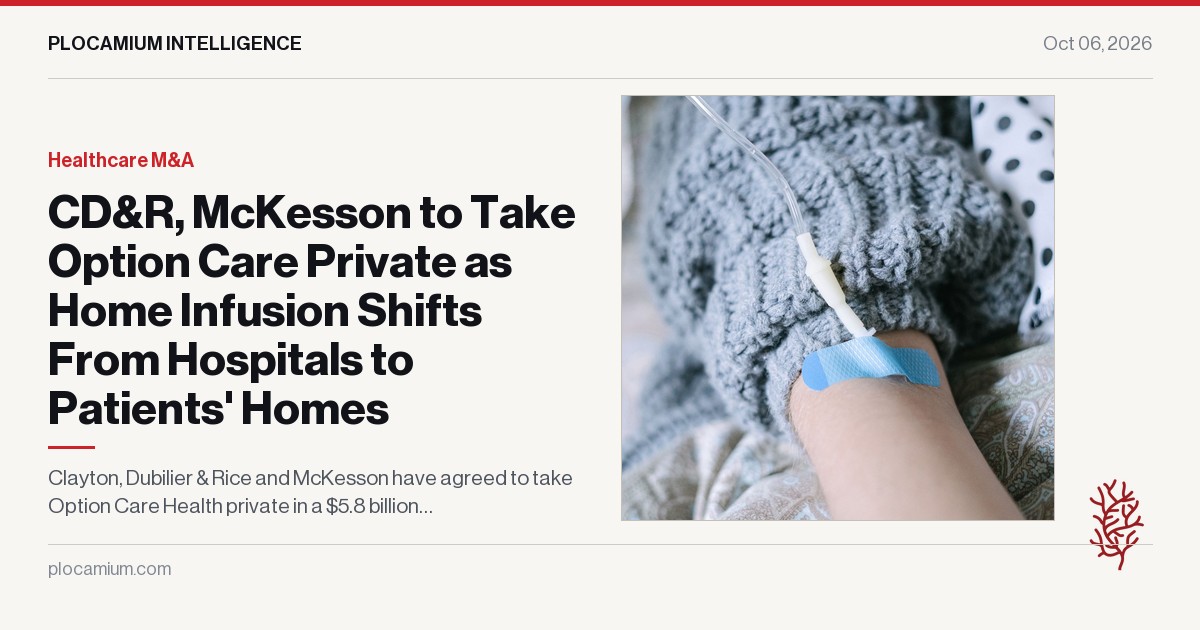
- CD&R and McKesson agreed to acquire Option Care Health for $5.8 billion enterprise value, making it one of the largest healthcare services take-privates of 2026.
- Option Care Health operates infusion services across all 50 US states with over 8,000 staff including more than 5,000 clinicians, positioning it to capture volume shifts from hospitals to home-based care.
- McKesson's participation as co-buyer is strategically significant because distributors rarely take equity stakes in downstream providers, indicating vertical integration into infusion services is viewed as essential to control the supply chain from pharmaceutical distribution through patient administration.
Clayton, Dubilier & Rice and McKesson have agreed to take Option Care Health private in a $5.8 billion transaction, betting that home and alternate site infusion services will continue gaining ground against traditional hospital-based care . The deal represents one of the largest healthcare services take-privates of 2026 and signals that institutional capital sees structural tailwinds in the shift of complex therapies from institutional settings to patients' homes.
$5.8 billion
the enterprise value that CD&R and McKesson are paying to acquire Option Care Health, which operates infusion services across all 50 US states with more than 8,000 staff including over 5,000 clinicians . The company delivers home-based and alternate site infusion therapies, a segment that has grown rapidly as payers and providers seek lower-cost alternatives to hospital administration of high-acuity treatments.
The transaction unites one of private equity's most active healthcare investors with the nation's largest pharmaceutical distributor. McKesson's participation as a co-buyer is particularly notable: distributors rarely take equity stakes in downstream service providers, suggesting McKesson views vertical integration into infusion services as strategically essential. The deal structure creates a controlled platform that can capture margin across the supply chain, from wholesale pharmaceutical distribution through final patient administration.
Why CD&R Is Doubling Down on Healthcare Services
CD&R has consistently pursued healthcare services businesses with defensible competitive positions and recurring revenue models. Option Care Health fits that thesis precisely. The company operates in a fragmented market where scale matters: larger infusion providers negotiate better reimbursement rates with payers, secure volume-based pricing from pharmaceutical manufacturers, and spread fixed costs across a broader patient base.
The home infusion market has structural growth drivers that transcend economic cycles. An aging population requires more chronic disease management. Specialty pharmaceuticals, particularly biologics for oncology, immunology, and rare diseases, increasingly require infusion administration. Payers actively steer patients toward lower-cost sites of care, and a home infusion visit costs a fraction of a hospital-based infusion. Option Care Health's network of over 5,000 clinicians positions it to capture that volume shift .
CD&R's strategy here mirrors its approach in prior healthcare services deals: acquire a scaled asset, invest in infrastructure and technology to improve clinical outcomes and operational efficiency, then either take the company public again or sell to a strategic buyer once the business reaches a larger scale. The firm has previously executed this playbook in pharmacy benefit management, physician practice management, and medical device distribution.
McKesson's Strategic Calculus
McKesson's role as co-investor deserves scrutiny. As the largest pharmaceutical distributor in North America, McKesson generates revenue by moving product from manufacturers to pharmacies, hospitals, and clinics. By taking a stake in Option Care Health, McKesson secures a captive channel for specialty pharmaceutical distribution, particularly high-value infusion therapies that carry better margins than traditional oral medications.
This vertical integration play has precedent. In recent years, major distributors and pharmacy chains have moved downstream into care delivery, recognizing that controlling the full value chain from drug procurement through patient administration creates competitive moats. McKesson's participation also suggests the company sees home infusion as a structural winner in the broader shift toward site-of-care optimization.
The timing aligns with trends visible across healthcare in 2026. The regulatory environment continues to favor lower-cost care settings. Commercial payers and Medicare Advantage plans increasingly use site-of-care policies to mandate that certain infusions occur in home or ambulatory settings rather than hospital outpatient departments. Option Care Health benefits directly from these policy shifts, and McKesson gains exposure to that tailwind.
Valuation Context and Deal Mechanics
The $5.8 billion valuation for Option Care Health provides a benchmark for the home infusion sector . While the source material does not disclose the purchase price per share or the implied valuation multiple, the deal size suggests CD&R and McKesson are paying a meaningful premium to take the company private. Option Care Health was publicly traded, and take-private transactions typically command premiums of 25 to 40 percent above the pre-announcement trading price to secure shareholder approval.
For context, healthcare services businesses with recurring revenue, high barriers to entry, and favorable reimbursement dynamics trade at elevated multiples. Comparable home health and infusion companies have traded in the range of 12 to 16 times EBITDA in recent transactions, though multiples vary based on growth rates and profitability margins. The involvement of a strategic co-investor like McKesson may justify a higher multiple, as strategic buyers often pay for synergies that pure financial buyers cannot capture.
The deal structure likely involves significant leverage, as is standard for large-cap buyouts. CD&R typically employs leverage ratios in the range of 4 to 5 times EBITDA for stable, cash-generative healthcare businesses. Option Care Health's recurring revenue base and contracted payer relationships make it suitable for leverage financing, even in a higher interest rate environment.
Broader M&A Momentum in Healthcare
The Option Care Health transaction arrives amid a resurgence in healthcare M&A activity in 2026. After a slower 2024 and 2025 marked by elevated interest rates and valuation disconnects, dealmaking has resumed as buyers and sellers have recalibrated expectations. Take-private transactions, in particular, have accelerated as private equity firms see value in publicly traded healthcare companies whose stock prices have not kept pace with earnings growth.
The healthcare services sector remains a priority target for institutional capital. Unlike drug development or medical device innovation, services businesses generate predictable cash flows, face lower regulatory risk, and benefit from demographic tailwinds that are difficult to disrupt. Home-based care models, in particular, have attracted significant capital. Investors recognize that the future of healthcare delivery involves fewer hospital admissions, shorter lengths of stay, and more care delivered in community and home settings.
This trend is visible across other recent transactions, though the Option Care Health deal stands out for its size and the involvement of a strategic co-investor. Smaller home health and hospice businesses have changed hands at robust valuations throughout 2026, and large infusion therapy platforms like Option Care Health represent the scaled end of that spectrum.
The Plocamium View
CD&R and McKesson are making a calculated bet that the home infusion market will consolidate and that the winners will be platforms with national scale, deep payer relationships, and integrated supply chains. We view this transaction as a leading indicator of broader vertical integration in specialty pharmaceuticals. Distributors and pharmacy benefit managers have historically operated as intermediaries, but they increasingly recognize that owning downstream care delivery assets allows them to capture more of the value chain and defend against disintermediation.
The strategic implication for institutional investors: healthcare services businesses with defensible market positions and exposure to site-of-care shifts are likely to trade at sustained premiums. Option Care Health's 8,000-person workforce, including over 5,000 clinicians, represents a physical asset base that cannot be easily replicated by new entrants or digital health startups . In an industry where labor costs and regulatory compliance create high barriers to entry, scaled incumbents have pricing power.
We also note the timing. Take-private activity accelerated in healthcare during 2026, suggesting that private equity firms see better risk-adjusted returns in taking proven businesses private, optimizing them away from public market scrutiny, and either re-IPO-ing or selling to strategics in three to five years. This deal fits that pattern. CD&R is not betting on a turnaround; it is betting on operational improvement and market consolidation in a sector with structural tailwinds.
The McKesson co-investment is the most telling detail. Strategic buyers rarely partner with private equity unless they see existential reasons to control an asset. McKesson's participation signals that large pharmaceutical distributors view home infusion as a must-win channel, not an optional adjacency. That should focus attention on other publicly traded infusion and home health companies as potential take-private candidates.
The Bottom Line
The $5.8 billion take-private of Option Care Health by CD&R and McKesson marks a pivotal moment in healthcare services M&A . The deal underscores that institutional capital is willing to deploy substantial sums to own scaled platforms in markets with clear structural demand drivers. Home and alternate site infusion services benefit from demographic aging, specialty pharmaceutical growth, and payer-driven site-of-care migration. CD&R gains a platform with national reach and a large clinical workforce. McKesson secures vertical integration into a distribution channel that is critical for high-margin specialty drugs.
For institutional investors, the message is clear: healthcare services businesses that control physical assets, maintain contracted payer relationships, and operate in markets with high barriers to entry will continue to command premium valuations. The consolidation wave in home-based care is accelerating, and the companies that achieve national scale will be the ultimate winners. Watch for additional take-private activity in adjacent sectors, particularly home health, hospice, and ambulatory surgery centers, as private equity and strategic buyers pursue similar integration strategies.
Sources
- [1] PE Hub. "CD&R and McKesson ink $5.8bn take-private deal for Option Care Health." pehub.com
- [2] Endpoints News. "AstraZeneca heralds new R&D facility in that 'other' Cambridge." endpoints.news
This report is for informational purposes only and does not constitute investment advice or an offer to buy or sell any security. Content is based on publicly available sources believed reliable but not guaranteed. Opinions and forward-looking statements are subject to change; past performance is not indicative of future results. Plocamium Holdings and its affiliates may hold positions in securities discussed herein. Readers should conduct independent due diligence and consult qualified advisors before making investment decisions.
© 2026 Plocamium Holdings. All rights reserved.