
Ireland Wins Tariff Reprieve as Trump Abandons Whiskey Duties
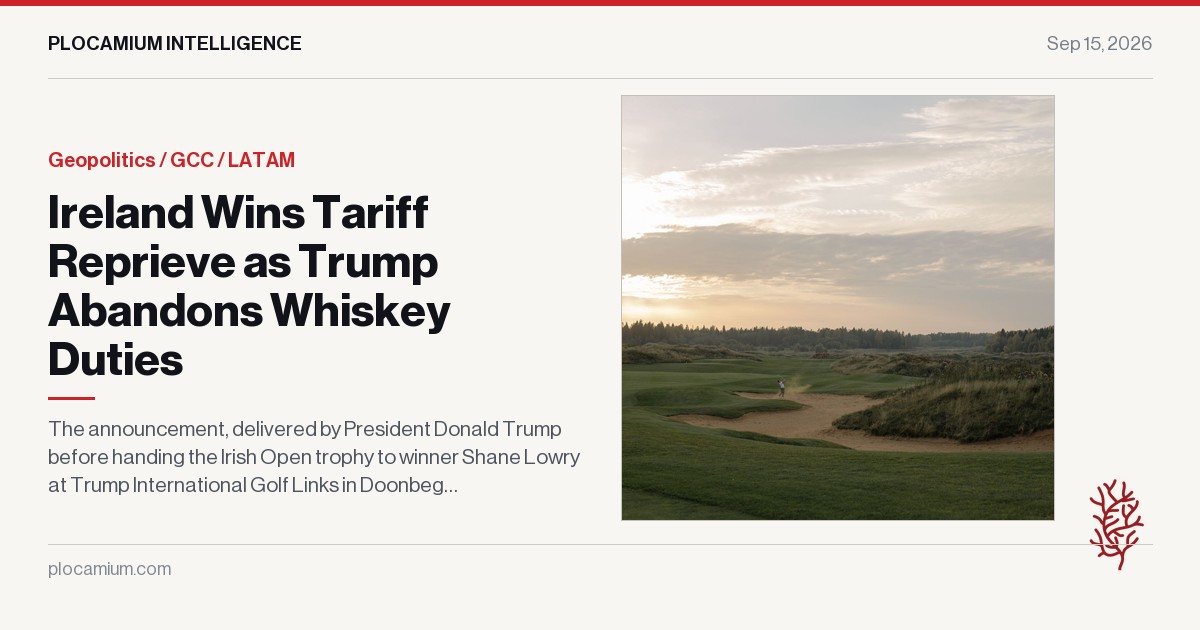
- Trump announced the removal of a 15% tariff on Irish whiskey at a golf trophy ceremony in County Clare on September 13, 2026, eliminating a cost disadvantage Republic of Ireland distillers faced since his May UK tariff deal.
- The tariff removal brings Republic of Ireland whiskey exports into tariff parity with Northern Ireland and the rest of the UK.
- President Trump said he discussed the tariff matter with both Taoiseach Micheál Martin and golfer Shane Lowry before making the announcement at Trump International Golf Links in Doonbeg, County Clare.
A presidential announcement made at a golf trophy ceremony in County Clare on September 13, 2026 removes the 15% tariff on Irish whiskey entering the United States, eliminating a structural cost disadvantage that Republic of Ireland distillers had carried since Trump's earlier UK tariff deal in May.
The announcement, delivered by President Donald Trump before handing the Irish Open trophy to winner Shane Lowry at Trump International Golf Links in Doonbeg, County Clare, brings the Republic of Ireland's whiskey exports into tariff parity with Northern Ireland and the rest of the UK. Trump told the assembled crowd he had discussed the matter with Taoiseach Micheál Martin and with Lowry directly. The removal applies to the standard 15% EU goods tariff that had applied to Irish whiskey from the Republic, according to BBC News .
Martin, who met Trump in Dublin on Saturday, said the president's comments did not come as a surprise. "He would make the point this is his view," Martin said, describing the united Ireland remarks that accompanied the visit as an "overreaction" in public discourse.
The tariff cut lands at a moment when Trump's trade architecture is reshaping capital flows on multiple continents simultaneously. Canadian Prime Minister Mark Carney is convening more than 100 global investors overseeing more than C$100 trillion ($72 trillion) in assets in Toronto this week, betting that sovereign wealth funds and asset managers will redirect capital toward Canada's energy and resource sectors as the US-Canada trade war deepens . The Irish whiskey announcement and the Toronto summit are separate events, but they share a structural logic: middle powers are now competing for preferential access inside Trump's tariff system, and the price of entry is personal diplomacy.
The Supply Chain Problem That Made This Announcement Necessary
The complexity of Irish whiskey production made the May UK tariff deal partially unworkable for the island's distilling industry. BBC News economics and business editor John Campbell explained the mechanism: newer distilleries across Northern Ireland bottle whiskey produced under licence while their own product matures, and the dominant service provider for that bottling is the Great Northern Distillery in Dundalk, County Louth, which sits in the Republic .
Because the liquid originates in the Republic, those Northern Irish brands were classified as EU rather than UK producers for tariff purposes, blocking them from the zero-tariff benefit Trump had already granted UK goods. The September 13 announcement resolves that classification problem entirely by removing the Irish whiskey tariff at the Republic level.
The implication for Northern Ireland distillers is that the competitive advantage they briefly held, the period between May and September 2026 when UK whiskey entered the US duty-free while Irish Republic whiskey paid 15%, is now eliminated. John Campbell noted this directly: removing the Irish tariff ends the advantage some Northern Ireland distillers had over competitors in the Republic .
The Great Northern Distillery in Dundalk sits at the center of an all-island supply chain that made the May UK tariff deal structurally incomplete. The September announcement fixes that gap, but it also neutralizes a six-month pricing edge for NI-based bottlers.
Doonbeg as a Geopolitical Asset: What the Golf Course Tells Institutional Investors
Trump's decision to anchor his Irish visit at his own resort in Doonbeg, a village in rural County Clare, is not incidental to the policy outcome. The Trump International Golf Links is described by local businessman Martin Kelly as "a massive employer" and the largest employer in the area at a scale comparable to Intel's role in Dublin. Publican Seoirse Comerford put the employment figure at over 300 people and described the course as "keeping Doonbeg alive" against the demographic attrition affecting rural west Clare .
The resort provides Trump with a physical stake in the Irish economy, a form of skin-in-the-game diplomacy that has no equivalent in traditional US-EU trade negotiations. Where formal channels between Washington and Brussels remain constrained by the 15% EU goods tariff regime, a personal relationship with the Taoiseach and a golf resort in County Clare created a lane for a product-specific carve-out that bypassed the broader EU negotiating framework entirely.
Our view: this is the template. Sector-specific tariff relief delivered through personal diplomatic channels, rather than formal trade agreements, is becoming Trump's preferred instrument. Irish whiskey is a small-volume trade flow. The precedent it sets for other EU member states seeking carve-outs is large.
The Canada Parallel: Middle Powers Competing for Tariff Access
The Toronto investor summit running September 14-15 illustrates the same dynamic at sovereign scale. Carney is pitching BlackRock's Larry Fink, Blackstone president Jon Gray, and sovereign wealth funds from the UAE and Norway on Canadian energy, AI, defence, and infrastructure, with a goal of building what his government calls a "more independent, more resilient economy" in the wake of the US-Canada trade conflict .
The Canada Pension Plan Investment Board, co-hosting the summit, issued a caution that is worth quoting in full. Naomi Powell, director of the CPP Investments Insight Institute, said: "Global capital is looking for opportunity, but opportunity alone does not make a market investible." The CPPIB report identified the scale and depth of investible opportunity as Canada's greatest weakness, pointing specifically to lengthy project approval timelines as a structural impediment .
Ireland faces no equivalent approval bottleneck in whiskey production. The sector is mature, export-oriented, and benefits from protected geographic indication status under EU law. The tariff removal is a direct earnings catalyst for distillers already operating at scale.
| Metric | Irish Republic Whiskey (Pre-Sept 13) | Irish Republic Whiskey (Post-Sept 13) | Northern Ireland Whiskey (Post-May) |
|---|---|---|---|
| US Tariff Rate | 15% (EU standard) | 0% (announced) | 0% (UK deal, May 2026) |
| Great Northern Distillery classification | EU producer | EU producer (tariff now irrelevant) | Previously blocked from UK rate |
| NI bottlers using GND liquid | Classified as EU, paid 15% | Tariff eliminated | Advantage removed |
Deregulation as a Parallel Macro Current: What the EPA Repeal Adds to the Picture
On the same day Trump left Shannon Airport, the US Environmental Protection Agency announced the repeal of rules limiting greenhouse gas emissions from coal and gas power plants. EPA Administrator Lee Zeldin said the changes would eliminate more than $300 billion in costs for power plants . A separate rule proposed alongside the repeal could prevent future administrations from reimposing greenhouse gas regulations on power plants.
The juxtaposition matters for institutional capital. Trump is simultaneously opening market access for a European agricultural product through personal diplomacy in Doonbeg and eliminating environmental compliance costs for US fossil fuel generators in Houston. These are not contradictory signals. They are two expressions of the same governing logic: regulatory and tariff architecture bends toward relationships and toward industries the administration has identified as strategic.
Our view: the EPA repeal reinforces the case that US energy infrastructure spending will accelerate independent of climate policy constraints. For the sovereign wealth funds Carney is courting in Toronto, including UAE capital with deep exposure to both fossil fuel revenues and clean energy transition assets, the US deregulatory posture complicates the clean energy narrative but strengthens the case for North American energy infrastructure broadly.
The Plocamium View
The Irish whiskey tariff removal is not a trade story. It is a market access story with a replicable mechanism.
What the market is pricing as a one-off personal favour from a president at his own golf resort is actually a proof of concept for bilateral product-level carve-outs within a multilateral tariff framework. The EU's 15% goods tariff remains intact. Irish whiskey is now outside it. That gap between the headline tariff rate and the effective rate paid by specific products will widen as more governments dispatch ministers and business leaders to cultivate direct relationships with the Trump administration.
The second-order play is in the Irish distilling sector itself. The Republic of Ireland's whiskey industry has grown substantially over the past decade, with dozens of new distilleries coming online since 2015. The 15% tariff had functioned as a price wedge in the US market, the world's largest whiskey consumption market by value. Removing it does not just restore competitive parity with Scotch whisky (which also carries UK tariff treatment post-May). It creates a window for Irish Republic brands to reprice aggressively into US retail and on-premise channels before any formal EU-US framework supersedes the announcement.
For PE funds with portfolio exposure to premium spirits, the Irish whiskey vertical just became materially more attractive on a forward revenue basis. The caveat: Trump announced the removal verbally at a trophy ceremony. Implementation requires formal regulatory action, and the announcement has not yet been codified. The risk of delay or partial implementation is real and should be reflected in any position sizing.
The Canada summit running in parallel this week is the larger institutional story. C$100 trillion in AUM in one room is not a photo opportunity. If Carney converts even a fraction of that attention into committed infrastructure capital, Canada's capacity to absorb the shock of US trade decoupling changes materially. The CPPIB's own warning about approval timelines is the most honest assessment of the risk. Investors who take the Toronto pitch seriously will demand regulatory reform as a condition of deployment, not an aspiration.
Trump's united Ireland comments, dismissed by Martin as an overreaction, are worth watching for a different reason. They signal that the president is treating Irish constitutional arrangements as negotiating currency, much as he treated Canadian sovereignty. Institutional investors with exposure to Northern Ireland's economy should monitor whether the political temperature affects the devolved government's stability.
The Bottom Line
Trump's Doonbeg announcement removes a 15% cost barrier for Irish whiskey exporters and signals that product-level tariff carve-outs are available to governments willing to engage Trump on his own terms and on his own turf. PE investors with premium spirits exposure should model the Irish whiskey revenue upside now, with implementation risk as the primary discount factor. The broader lesson is structural: in Trump's second term, trade policy is personal, sectoral, and faster-moving than any WTO framework. Capital that can read those relationships early will price assets that formal trade models will misprice for months.
References
BBC News. "Trump says he will remove all Irish whiskey tariffs as he ends two-day visit." https://www.bbc.co.uk/news/articles/cx2z79n0eeno BBC News. "Carney gambles on the world's biggest investors betting on Canada." https://www.bbc.co.uk/news/articles/c0m3neyyzm7o Al Jazeera / AP / Reuters. "US repeals rules limiting greenhouse gas emissions by power plants." https://www.aljazeera.com/news/2026/9/14/us-repeals-rules-limiting-greenhouse-gas-emissions-by-power-plantsThis report is for informational purposes only and does not constitute investment advice or an offer to buy or sell any security. Content is based on publicly available sources believed reliable but not guaranteed. Opinions and forward-looking statements are subject to change; past performance is not indicative of future results. Plocamium Holdings and its affiliates may hold positions in securities discussed herein. Readers should conduct independent due diligence and consult qualified advisors before making investment decisions.
© 2026 Plocamium Holdings. All rights reserved.