
Oil Surges on Iran War Fears, Forcing Pump Prices Up Five Pence
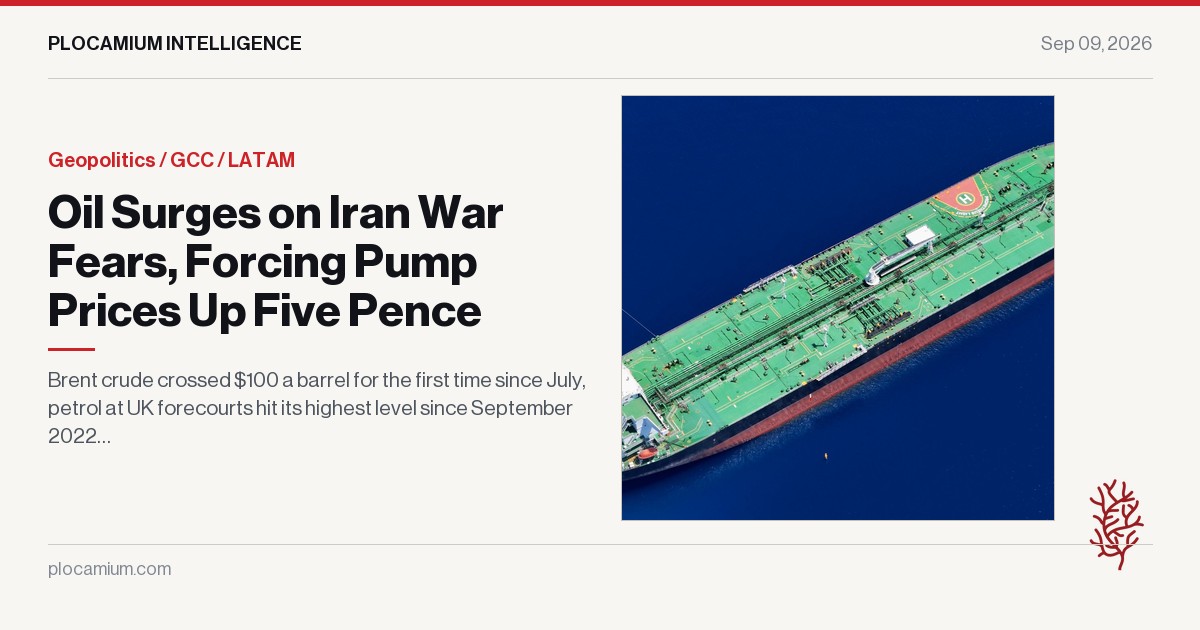
- Brent crude crossed $100 a barrel for the first time since July following US-Israel military escalation with Iran.
- UK petrol prices reached their highest level since September 2022, with pump prices rising five pence.
- A Northern Ireland electricity supplier announced a 12.6% tariff increase on the same day as oil price surges.
September 9, 2026 | Plocamium Holdings Institutional Research
Brent crude crossed $100 a barrel for the first time since July, petrol at UK forecourts hit its highest level since September 2022, and a Northern Ireland electricity supplier announced a 12.6% tariff increase, all on the same day. The US-Israel war with Iran is no longer an abstract geopolitical risk for institutional portfolios. It is a live transmission mechanism moving from tanker strikes in the Strait of Hormuz directly into consumer wallets across the British Isles.
The chain of events is now documented and sequential. US forces struck five Iranian tankers on Tuesday after Tehran targeted an American warship. Yemen's Iran-backed Houthi movement simultaneously attacked oil facilities in Saudi Arabia. Brent, which traded near $70 before the conflict began at the end of February, surged to $100. The RAC reported that average unleaded petrol prices in the UK reached 167.17 pence per litre, up 5p in a single week, the largest weekly increase since April. Diesel moved to 188.63p per litre, also up 5p. The cost of filling a family-sized car rose by £2.75 in seven days . Separately, Share Energy, a Northern Ireland electricity supplier with 41,092 customers, announced it would raise electricity tariffs by 12.6% from October 1, citing wholesale energy cost pressures and Middle East instability as direct causes .
RAC senior policy officer Rod Dennis stated that the weekly average oil price had reached $96 per barrel, a figure now feeding through to forecourt prices with minimal lag. "Drivers are having to dig ever deeper into their pockets every time they fill up, and there's no sign of any relief yet," Dennis said .
The nut paragraph writes itself. When military escalation in the Strait of Hormuz translates within days into higher electricity bills in Belfast and higher petrol costs in Birmingham, the transmission from geopolitical event to household balance sheet has compressed to near-zero latency. For institutional investors, the question is no longer whether oil-price volatility is priced into consumer-facing equities and fixed income. It is whether the second and third-order effects, energy retail margin compression, consumer spending withdrawal, and sovereign cost-of-living pressure, have been adequately modeled.
The Price Corridor: $70 to $120 and What Lives in Between
The data points from the source material define a clear corridor. Brent traded near $70 before the conflict began in late February. It spiked to $120 in April, the peak to date. It has since retreated to $100, with a weekly average of $96 for the period ending September 9 .
| Price Point | Brent Crude ($/barrel) | UK Petrol (p/litre) | Context |
|---|---|---|---|
| Pre-conflict (Feb 2026) | ~$70 | Not disclosed | Baseline before US-Israel-Iran hostilities |
| April 2026 peak | $120 | Not disclosed | Peak escalation, diesel hit 191.54p |
| July 2026 | Last below $100 | Not disclosed | Brief deescalation window |
| September 9, 2026 | $100 | 167.17p | Current, post-tanker strikes |
The April diesel peak of 191.54p per litre is the reference ceiling. At 188.63p today, diesel sits 2.91p below that level, suggesting limited additional buffer before April records are broken if Brent sustains above $100. The last time petrol was priced at current levels was September 2022, a period institutional investors will recall as the post-Ukraine energy shock that forced emergency government intervention across Europe .
Brent at $100 on September 9, 2026, sits 42.9% above the pre-conflict baseline of $70. The April peak of $120 represents a 71.4% move from that same baseline. The current level is not a ceiling. It is a midpoint.
Share Energy's 12.6% Increase: The Retail Margin Problem Made Explicit
Share Energy's decision to raise electricity tariffs by 12.6% effective October 1 is instructive not because the company is large, it serves 41,092 customers in Northern Ireland, 40,675 domestic and 417 commercial, but because its CEO Damian Wilson articulated precisely what the wholesale price shock is doing to retail energy economics .
Wilson stated that Share Energy had been "operationally profitable" since April, implying the company absorbed wholesale cost increases for months before passing them through. The Consumer Council for Northern Ireland quantified the consumer impact: credit and prepayment customers will see annual electricity costs rise by approximately £129 per year .
The broader Northern Ireland energy market context compounds the picture. SSE Airtricity, Firmus Energy, and Budget Energy have all announced price increases recently. Wilson himself called on the government to address the Northern Ireland electricity sector's structural over-reliance on gas, a dependency that makes regional pricing acutely sensitive to any Middle East supply disruption .
Our view: Share Energy's profit-sharing model, which commits 50% of profits to qualifying customers with the first distribution expected in 2028, represents an unusual structural design for a retail energy provider. With the company targeting operational profitability from a 41,000-customer base while absorbing a $96-per-barrel oil environment, the 2028 profit share timeline now carries meaningful execution risk if Brent sustains above $100 through winter 2026-2027.
Capital Flight Compounds the Fiscal Arithmetic
The same day Brent touched $100, a separate but connected story surfaced. Chris Rokos, ranked third in The Sunday Times list of Britain's top taxpayers and reported to have paid £330m in taxes last year, is departing the UK for Greece. Greece's non-dom regime caps the annual tax liability on overseas income for qualifying wealthy foreigners at a flat €100,000, equivalent to £86,000 .
Dan Neidle, founder of Tax Policy Associates, told the BBC's Today programme that £330m in annual tax revenue was "enough to fund 4,500 teachers" and that "we have entire taxes that raise less than £330m." He acknowledged there are "no easy answers and no good statistics" on the scale of ultra-wealthy taxpayer departures, and that the Treasury's own data on the phenomenon is thin. "We have lots of anecdotes. What we don't really have is data," Neidle said .
The implication for fiscal capacity is direct. A government facing rising borrowing costs, a Chancellor declining to rule out tax increases in an October 28 budget, and simultaneous consumer energy cost pressures has less room to deploy household relief measures if its high-net-worth tax base is repricing domicile risk. Rokos's departure, first reported by Bloomberg, is a data point rather than a trend. But it is a data point arriving at the worst possible moment .
The Houthi-Saudi Attack Vector: Why the Risk Premium Stays Elevated
Tuesday's Houthi attack on Saudi oil facilities introduces a supply-side variable that is structurally different from tanker interdiction. Tanker strikes disrupt transport. Attacks on Saudi production infrastructure threaten the feedstock itself.
The source material confirms US forces struck five Iranian tankers in retaliation for Tehran targeting an American warship. The Houthi attack on Saudi facilities occurred on the same day . The simultaneity of these events, tanker interdiction plus production-site targeting, is the combination that drove Brent back to $100 and explains why the RAC's Rod Dennis offered no timeline for price relief.
Our view: Markets are pricing a $96 weekly average, not the $100 spot. The spread between the two is narrow, but it matters for downstream fuel pricing models. If Houthi attacks on Saudi facilities prove effective in reducing output, the $120 April ceiling becomes a reference point rather than an outlier. Energy infrastructure equities, particularly those with Middle East upstream exposure, carry asymmetric upside in a sustained escalation scenario. Consumer discretionary positions in the UK carry the inverse.
The Plocamium View
The surface story is an oil price spike. The institutional story is a convergence of three compounding pressures hitting UK households and the UK fiscal position simultaneously: a Middle East conflict driving energy costs to multi-year highs, a retail energy sector with structurally thin margins now forced to pass through wholesale costs after months of absorption, and a high-net-worth taxpayer base actively repricing UK domicile risk ahead of a Budget that may deliver further adverse signals.
None of these three vectors is new in isolation. The combination, arriving together in September 2026 ahead of a winter demand peak, is the variable that institutional models need to stress-test.
The second-order play is in UK consumer credit and UK retail fixed income. A 5p-per-litre weekly petrol increase and a 12.6% electricity tariff rise hitting simultaneously in autumn, when heating demand begins to climb, compresses household disposable income at a rate that mid-2026 underwriting assumptions likely did not model. Consumer credit portfolios with UK exposure written at 2025 delinquency baselines are underpriced for this environment.
The third-order play is the sovereign. Chancellor John Healey's refusal to rule out tax increases in the October 28 Budget, combined with Rokos-type departures reducing the high-end tax base, means the UK government faces a revenue squeeze precisely when the political pressure to provide cost-of-living relief is rising. The resolution is either higher taxes on a shrinking base, reduced relief spending, or additional borrowing into a market already pricing UK gilts at historically elevated yields.
Plocamium's position: energy transition infrastructure in GCC states with domestic refining capacity and insulated pricing regimes represents the cleanest hedge to prolonged Middle East instability. The risk is not that the conflict ends quickly. The risk is that institutional capital prices a resolution that the military timeline does not support.
The Bottom Line
Brent at $100 on September 9, 2026, is not a spike. It is a floor, established by tanker strikes, Houthi attacks on Saudi facilities, and US military engagement that shows no near-term de-escalation path. UK consumers are absorbing a 5p-per-litre weekly petrol increase and a 12.6% electricity tariff rise in parallel. The fiscal cushion that might normally fund government relief is being eroded by capital flight from high-net-worth taxpayers repricing their UK exposure. Winter demand has not yet arrived. The $120 April ceiling should be modeled as a base case, not a tail risk, for any institutional portfolio with UK consumer, energy retail, or sovereign exposure through Q1 2027.
References
BBC News. Musafer, Shanaz. "Petrol prices rise by 5p over a week as Iran war sends oil higher." Published 9 September 2026. https://www.bbc.co.uk/news/articles/cj4jwlx77lro BBC News. Fleck, Holly. "Share Energy to increase electricity prices by 12.6%." Published 9 September 2026. https://www.bbc.co.uk/news/articles/c86x0v4ey5yo BBC News. Sheridan, Raphael and Labiak, Mitchell. "UK's third-biggest taxpayer to leave for Greece." Published 8 September 2026. https://www.bbc.co.uk/news/articles/cvgynjlzk8zoThis report is for informational purposes only and does not constitute investment advice or an offer to buy or sell any security. Content is based on publicly available sources believed reliable but not guaranteed. Opinions and forward-looking statements are subject to change; past performance is not indicative of future results. Plocamium Holdings and its affiliates may hold positions in securities discussed herein. Readers should conduct independent due diligence and consult qualified advisors before making investment decisions.
© 2026 Plocamium Holdings. All rights reserved.